

Living in Wilmington means your outdoor space can feel perfect in April, unbearable in July, and drafty in January. A lot of porches and patios end up being used part-time simply because no one planned for all four seasons from the start. This guide fixes that.
Whether you’re starting from scratch or upgrading what you already have, here’s a clear breakdown of every realistic option for creating a comfortable, year-round outdoor room in coastal NC, what each one costs, how long you’ll actually use it, and which one makes the most sense for your situation.
Want a recommendation based on your specific property, porch exposure, and budget? Reach out to our team for a no-pressure conversation.
Homeowners researching four-season outdoor rooms in Wilmington quickly discover that the right answer depends heavily on three things: how enclosed you want the space to feel, what problems you’re actually trying to solve, and how many months per year justify the investment. Here’s how to work through all of that.
Start Here: What Does “Year-Round” Actually Mean in Coastal NC?
Before pricing anything, get honest about your comfort goal. “Year-round use” means different things to different homeowners, and misaligning the structure to the goal is the most common reason outdoor spaces disappoint.
Here are the three common targets:
- Extended seasonal use: Comfortable for most of the year on mild days, but you still feel outdoor temperatures. Good enough for 8 to 10 months.
- Weather-protected use: Reduced wind, rain, pollen, and insects. Flexible ventilation on nice days. Comfortable in all but the coldest or hottest weeks.
- Indoor-like comfort: Heating and cooling, climate-controlled, usable every single month regardless of what’s happening outside.
Also name the main problem you’re actually solving. Mosquitoes and no-see-ums? Wind-driven rain? Summer heat? Coastal pollen? Your top issue should lead the design, because every option below solves a different set of problems.
Option 1: Open Porch Upgrades: Lowest Cost, Shortest Season
If you love fresh air and want to improve your existing open porch without enclosing it, targeted upgrades can meaningfully extend your usable season. This is the entry-level path.
Useful upgrades for an open coastal porch include:
- Ceiling fans to move air and reduce mosquito pressure, since mosquitoes are weak fliers and struggle in moving air
- A roof cover or extended overhang to block direct sun and light rain
- Outdoor roller shades for low-angle sun control and wind buffering on mild days
- Bug-discouraging lighting positioned away from seating areas
- Corrosion-resistant hardware throughout, since salt air accelerates rust on standard fasteners
What this solves: Summer airflow, shade, minor bug reduction, light rain protection.
What it doesn’t solve: Cold winter wind, heavy rain, insects on humid evenings, summer heat above 85 degrees.
Realistic usable months: 5 to 6.
This approach works well as a starting point when budget is tight, but it rarely delivers true year-round use in Wilmington’s climate.
Option 2: Screened Porch: Bug Control Without Losing the Breeze
A screened porch is one of the most popular upgrades in Wilmington because it keeps the open-air feel while blocking insects and wind-blown debris. If bugs are your primary frustration, this is often the right first step.
For coastal NC, material spec matters considerably. Salt air corrodes standard hardware quickly. Key choices that hold up near the coast:
- Corrosion-resistant aluminum framing and fasteners throughout
- Moisture-resistant trim and components in areas exposed to rain splash
- Tighter no-see-um mesh if standard mesh isn’t catching the small insects common along the NC coast
- Serviceable panels so that a damaged screen can be replaced quickly without a contractor
What this solves: Insects, wind-blown debris, some light rain filtering.
What it doesn’t solve: Cold winter wind, heavy rain, temperature extremes.
Realistic usable months: 7 to 8.
A screened porch also serves as a strong foundation to build on. Many homeowners start here and add panel systems later to extend the season further.
Option 3: Three-Season Enclosure or Porch Conversion: The Middle-Ground Sweet Spot
A three-season enclosure adds flexible glazed panels to a screened porch or covered patio, turning it into a space that’s comfortable from early spring through late fall. This is the most popular upgrade path for Wilmington homeowners who have an existing covered porch.
The most common system for this is WeatherMaster porch windows, which use a four-track vertical stacking design. Panels slide up or down to open the space fully on a nice day or close it completely during wind-driven rain. The system allows up to 75% ventilation when open, which preserves the outdoor feel that makes Wilmington living worthwhile.
If you already have a covered porch with a sound roof and floor, converting it to a three-season enclosure is also the most cost-effective upgrade available. You’re reusing the existing structure rather than building from scratch, which cuts the project cost significantly. The value-per-dollar on a porch conversion is hard to beat in this market.
What this solves: Insects, wind, pollen, light to moderate rain, cooler spring and fall temperatures.
What it doesn’t solve: True winter comfort or peak summer heat without additional heating or cooling.
Realistic usable months: 8 to 10.
One thing to plan for with enclosed spaces in coastal NC: moisture. Once you reduce natural ventilation, humidity can build up inside. Ceiling fans and deliberate ventilation design keep this from becoming a problem.
Option 4: Four-Season Insulated Sunroom: Full Year-Round Comfort
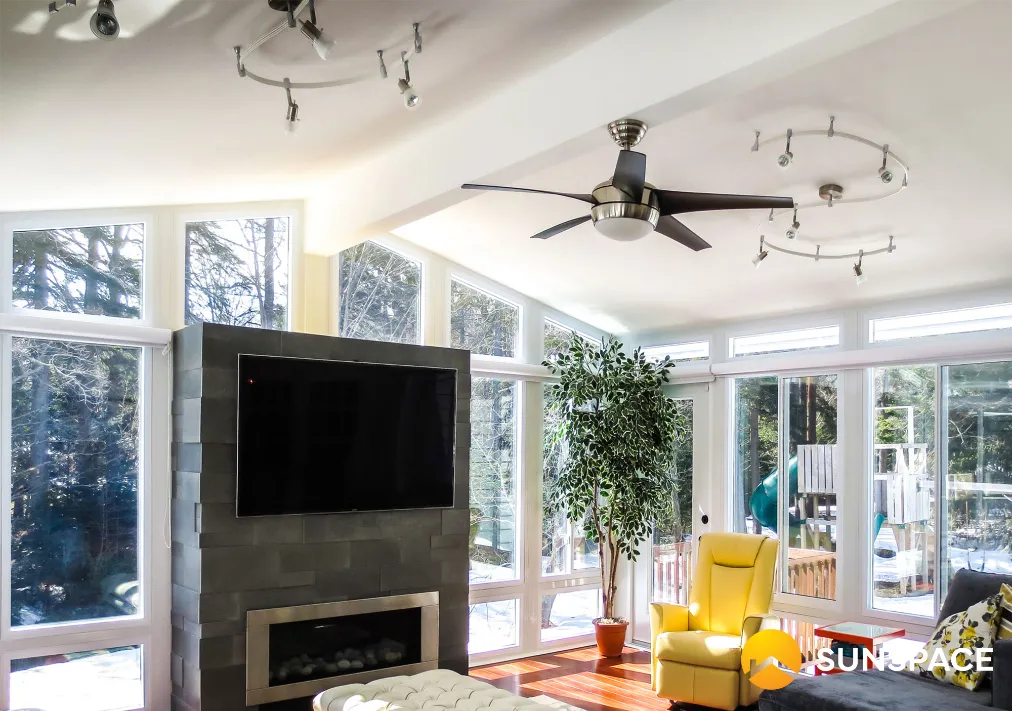
A four-season sunroom is what the name says: a climate-controlled enclosed room you can use comfortably in January and in August. It requires insulated wall panels, thermally broken aluminum framing, high-performance glazing, and a dedicated heating and cooling solution, typically a ductless mini-split.
This is the most substantial investment of the four options, and also the one that removes all seasonal planning. You’re not swapping panels twice a year, chasing drafts before guests arrive, or avoiding the space in July. It functions as an additional room of your home, with all the comfort that implies.
The four-season sunroom also does something the other options can’t: it adds conditioned, measurable square footage to your home. That affects resale value differently than an open patio or screened porch, and it also acts as a thermal buffer between your home’s interior and the outdoor climate, which can reduce heating and cooling load on your main living space year-round.
What this solves: All weather limitations. Insects, rain, heat, cold, humidity.
What it doesn’t solve: Nothing, within normal seasonal range.
Realistic usable months: 12.
For homeowners who want to understand how insulation specifically affects year-round comfort and energy costs in a coastal climate, the energy-saving benefits of insulated sunrooms cover the performance details in depth.
Coastal NC Must-Haves Across All Options
Regardless of which structure you choose, three realities shape every outdoor project in Wilmington:
Moisture control: Enclosed spaces trap humidity faster in a coastal climate than in drier regions. Every enclosed structure needs deliberate airflow planning, ceiling fans, ventilation panels, or HVAC to prevent the damp feeling that makes a space uncomfortable to use.
Salt air corrosion: Standard hardware, fasteners, and frame finishes deteriorate noticeably faster within a few miles of the coast. Corrosion-resistant components, powder-coated aluminum framing, and stainless steel fasteners aren’t optional upgrades here. They’re what separates a structure that looks great after ten years from one that’s showing rust and pitting after three.
Wind exposure: Coastal NC properties can fall into higher wind design zones depending on proximity to the water. Rated products and proper structural attachments are part of building anything that will hold up through Nor’easters and tropical storms.
How the Options Compare
| Option | Upfront Cost | Usable Months | Solves Bugs | Solves Rain | Climate Controlled | Home Value Impact |
| Open Porch Upgrades | Lowest | 5 to 6 | Partially | No | No | Minimal |
| Screened Porch | Lower | 7 to 8 | Yes | Partially | No | Moderate |
| Three-Season Enclosure | Moderate | 8 to 10 | Yes | Yes | No | Moderate |
| Four-Season Sunroom | Higher | 12 | Yes | Yes | Yes | Strong |
The Phased Approach: Spreading the Investment Over Time
For budget-conscious homeowners, building in phases is a practical strategy. You start with a covered patio or screen room, use the space, then add enclosure or climate control later. Many systems, including WeatherMaster porch windows, are specifically designed to allow upgrades. A screen room built on compatible framing can be converted to a three-season enclosure by swapping screen panels for glazed ones.
The key is working with a contractor who builds with future upgrades in mind from the start, not one who locks you into a system that can’t be expanded. The cost of choosing the wrong framing system upfront often exceeds the savings from the lower initial bid.
Before committing to any estimate, “How to Compare Sunroom Quotes in NC” walks through exactly what line items to look for so you can evaluate bids accurately rather than just comparing bottom-line numbers.
A Simple Decision Guide
Use these decision points to narrow down your path:
- If insects are the primary problem, start with a screened porch and no-see-um mesh on the screen doors.
- If wind and pollen are your main frustrations, move to a three-season enclosure with porch window panels.
- If humidity is the main issue, prioritize ventilation design and ceiling fans in any enclosed option.
- If you want indoor furniture, electronics, or a home office out there, plan for a tighter enclosure with conditioned comfort from the start.
- If you’re on a tight budget now but want more later, choose framing and materials that support future upgrades rather than locking yourself in.
Also be honest about maintenance tolerance. If you won’t swap seasonal panels twice a year, lean toward a more permanent system even if the upfront cost is higher.
Frequently Asked Questions
Can I winterize my screened porch every year instead of enclosing it permanently?
Yes. Common seasonal options include vinyl curtains, acrylic panels, and porch window systems. Each has trade-offs in warmth, durability, and appearance. A permanent enclosure eliminates the seasonal setup work and usually performs better than a temporary solution at any given temperature.
Do ceiling fans actually reduce mosquitoes on a porch?
They help. Mosquitoes are weak fliers, and moving air makes it harder for them to land and bite. Fans don’t eliminate the problem on a heavily infested evening, but they meaningfully reduce pressure and improve comfort when combined with screens.
How do I prevent a damp feeling after I add panels to my porch?
Plan for airflow before the panels go in. Ceiling fans, operable panels, and ventilation details in the roof design keep air circulating in an enclosed coastal space. The mistake is sealing a space tightly without accounting for humidity management.
Is a three-season room or a four-season sunroom worth more at resale in Wilmington?
A four-season insulated sunroom typically adds more formal resale value because it counts as conditioned square footage. Three-season rooms and screened porches improve buyer appeal but don’t change the home’s appraised square footage in the same way.
How much does it cost to convert an existing screened porch to a three-season room?
Cost varies by porch size, existing structural condition, and the enclosure system chosen. Converting an existing covered porch is generally more affordable than building from scratch because the roof and floor are already in place. Getting a detailed, itemized quote from a local contractor is the most reliable way to plan your budget for your specific situation.
Talk to a Local Team Before You Decide
Every property in Wilmington is different. Lot orientation, sun exposure, existing porch structure, HOA rules, and how you actually live in the space all factor into the right recommendation. Eastern Sunrooms has been helping coastal NC homeowners build practical, well-built outdoor living spaces for over a decade. Contact our team to get a recommendation that fits your goals, your porch exposure, and your budget, whether that’s a screen room, a three-season system, or a full four-season conversion.